The M&L technology approach
Industrial Production Monitoring & Automation
Monitor I/O data from production lines, machines, energy infrastructure and security systems from a central point, and automatically respond to faults, downtime and critical events.

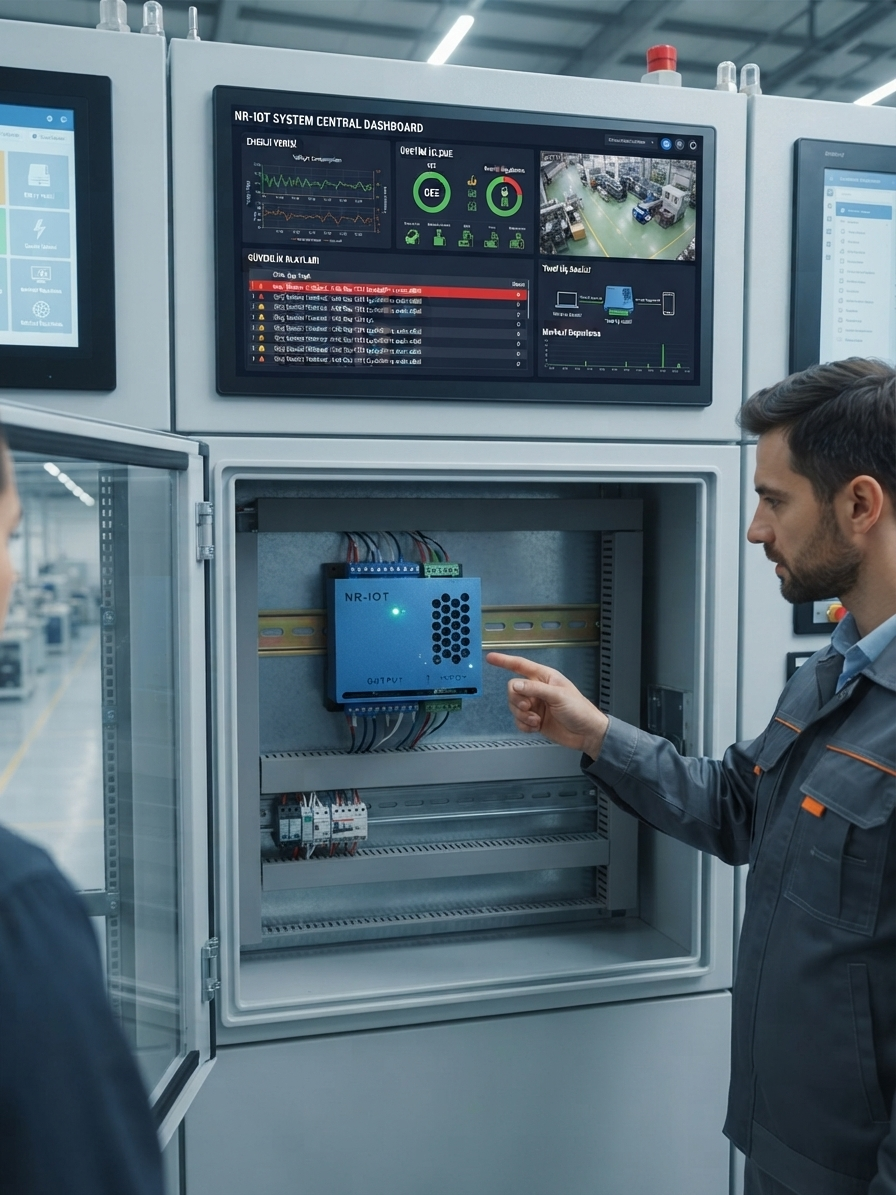
Turn Production Floor Signals into Real-Time Decisions
In an industrial facility, it is not enough for machines to simply operate. Operators and software systems need to know what is happening on the production floor and respond immediately when something changes. NetRelay creates a flexible control layer between machines, sensors, dry contacts and central production software.
With digital inputs, 250V / 10A relay outputs, analog inputs and expansion interfaces, NetRelay can monitor machine status, fault contacts, production counter signals, cabinet doors, temperature, humidity, current and other field information. Data can be transferred to central applications through MQTT, TCP or HTTP.
Production Counting and Line Speed
Pulse signals from photoelectric sensors, conveyors, packaging machines or production lines can be monitored through digital inputs. Each product pulse can be counted to calculate real-time production quantity, line speed and shift performance.
Machine Running, Stopped and Fault Status
Machine running, stop and fault contacts can be connected directly to NetRelay digital inputs. When an unexpected machine stop occurs, the event can immediately be transmitted to the central software through MQTT, TCP or HTTP.
Downtime and OEE Data Collection
Running signals, production pulses and fault information can be used to calculate actual operating time, unplanned downtime and total production. These field signals can become the data foundation for OEE, capacity utilization and shift performance dashboards.
Barcode-Based Production Tracking
Data from compatible serial barcode readers can be transferred to a production server through the integrated TCP Socket Client architecture. Product IDs, work orders and serial numbers can therefore be connected directly to production operations.
Compressor Monitoring
Running and fault contacts from industrial compressors can be monitored remotely. Unexpected shutdowns, excessive runtime or alarm conditions can automatically generate events in a central maintenance system.
Pump and Motor Monitoring
Running, stopped and thermal fault contacts from pump control panels can be monitored through digital inputs. Fault conditions can be reported automatically and, where appropriate, relay outputs can be used as part of standard control workflows.
Energy and Current Monitoring
Current transformers or suitable current sensors can be used to verify whether equipment is actually operating. Abnormal current conditions can indicate shutdowns, overloads or mechanical problems and can trigger automated notifications.
Generator Remote Control and Monitoring
Generators supporting remote start-stop interfaces can be controlled through relay outputs, while running, fault and other status contacts can be monitored through digital inputs.
Power Failure and Generator Transfer Monitoring
Utility power failure, generator activation and transfer back to the grid can be recorded as individual events and sent to the central monitoring platform with timestamps.
Electrical Cabinet and Technical Area Security
Electrical cabinets, automation panels and technical rooms can be monitored using magnetic contacts. Unexpected cabinet opening events can immediately be forwarded to maintenance or security systems.
Temperature and Environmental Control
Temperature sensors can monitor electrical cabinets, control rooms and server enclosures. When a configured threshold is exceeded, fans, cooling equipment or alarm relays can be activated automatically.
Centralized I/O Monitoring
Multiple NetRelay devices located across a facility can communicate with a central server through Ethernet, Wi-Fi, MQTT or TCP. Machine states, pumps, generators, cabinet doors, temperatures and active alarms can therefore be visualized from a single software interface.
Local Operation Without Internet Dependency
Industrial automation should not depend on continuous Internet availability. NetRelay can operate over the local Ethernet network using a local MQTT broker, TCP communication or HTTP services. Optional RTC and MicroSD modules can provide local timekeeping and event logging.
A Real Production Scenario
Consider a production machine where IN1 represents machine running status, IN2 represents machine fault, IN3 receives production counter pulses and IN4 monitors the electrical cabinet door. RELAY1 controls a warning beacon and RELAY2 controls a ventilation fan.
When the machine starts, the central system begins calculating runtime. Each product increases the production counter through IN3. If a fault occurs on IN2, NetRelay immediately sends an MQTT event to the maintenance system and activates the warning beacon through RELAY1. If the cabinet temperature exceeds the configured threshold, RELAY2 starts the ventilation fan. Opening the cabinet door creates a separate security event.
This allows a single NetRelay device to combine production monitoring, downtime tracking, alarm management, environmental control and security monitoring at one field location.
Connect Existing Software to the Production Floor
HTTP GET/POST, MQTT, WebSocket and TCP support enables NetRelay to connect existing ERP, MES and monitoring applications — or your own custom production software — directly to physical I/O. Integrations can be developed using Python, Node.js, C#, VB.NET, PHP, Delphi and other technologies.
Do not leave production floor contacts as isolated electrical signals. Turn them into measurable, recordable and software-controlled data with NetRelay.
Example Applications
- Production counting and conveyor monitoring
- Machine running, stop and fault tracking
- OEE and production KPI data collection
- Barcode-based production tracking
- Compressor status monitoring
- Pump and motor fault monitoring
- Current-based equipment monitoring
- Power failure and energy infrastructure monitoring
- Generator start-stop and status monitoring
- Electrical cabinet security monitoring
- Temperature and environmental monitoring
- Centralized MQTT-based factory I/O monitoring
- Automatic alarm and notification workflows
- Local MicroSD event and I/O logging