The M&L technology approach
Machine Runtime and Production Output Monitoring with NetRelay
An industrial production monitoring project that uses NetRelay to collect and compare machine runtime, downtime, fault duration and production output across manufacturing lines.
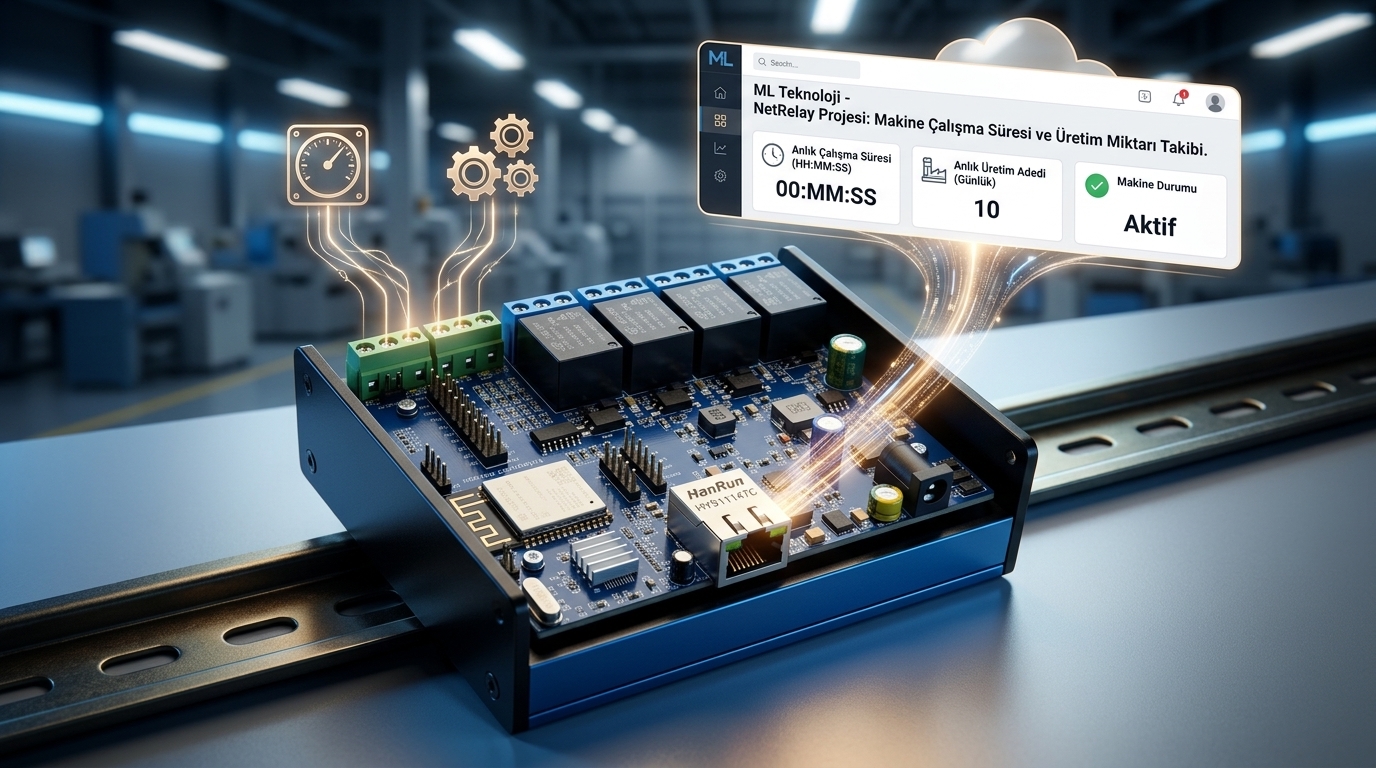
Within the scope of this project, a NetRelay-based production monitoring system was developed to automatically track machine runtime, downtime and production output across manufacturing lines.
Machine running, stopped, fault and product-count signals are collected through NetRelay digital inputs. The data is transmitted to a central server over Ethernet or Wi-Fi and compared by machine, production line, shift and work order.
Automated Machine Data Collection
PLC outputs, signal lamps, auxiliary relay contacts or sensors indicating whether a machine is running, idle, stopped or in a fault condition can be connected to NetRelay digital inputs.
A counting pulse, photocell signal or PLC production output generated for each completed product can be monitored through a separate input. This allows machine status and actual production quantities to be recorded on the same timeline.
Runtime, Downtime and Fault Monitoring
NetRelay transmits machine status changes to the central system in real time. The software records when each machine starts, stops, restarts or enters a fault condition and calculates total runtime and downtime.
Downtime reasons such as planned breaks, maintenance, product changeovers, material shortages, operator delays and technical failures can be selected through an operator interface or received automatically from the PLC.
Production Output Tracking
Actual production quantities are automatically calculated using signals received from product sensors, machine counters or PLC outputs. Total production can be monitored by machine, production line, shift, product, operator and work order.
Good and rejected product signals can be collected through separate inputs, allowing accepted output, scrap and total production quantities to be tracked independently.
Runtime and Production Output Comparison
The system compares the number of products manufactured during each machine's operating time and calculates hourly or per-minute production rates. Machines producing the same product can be evaluated using common performance criteria.
Machines that operate for extended periods without reaching the expected production quantity can be identified. This makes micro-stoppages, speed losses, mechanical problems, material feeding issues and operator-related performance differences visible.
Target vs Actual Production Analysis
Planned cycle time, hourly capacity and shift targets can be defined for every product and machine. Actual production output is continuously compared with these target values.
Automatic alerts can be generated when a machine falls behind its target, its cycle time increases or no product is produced for a predefined period.
Production Line and Machine Performance Comparison
Multiple production lines and machines can be monitored through a single centralized dashboard. Total runtime, net production time, downtime, output quantity, scrap rate and hourly performance can be compared.
Performance differences between similar machines can be reported and used for maintenance planning, capacity analysis and continuous production improvement.
MQTT and Centralized Communication
NetRelay devices can transmit digital input states and counter data to a central server through MQTT. Machines located in different buildings, departments, factories or branches can be combined within a common production monitoring platform.
Device connectivity can be monitored continuously and alarms can be generated for offline units. For internet-based installations, security measures such as VPN connectivity, user authentication and authorized MQTT communication can be implemented.
Control and Notification Scenarios
NetRelay relay outputs can control signal lamps, audible alarms and external notification equipment according to machine conditions. Email, SMS or mobile notifications can be sent to responsible personnel when extended downtime, low production speed or a target deviation occurs.
Remote machine starting or stopping can only be implemented as a project-specific function after considering machine safety requirements, authorization controls and existing safety circuits.
Reporting and Historical Analysis
Machine conditions, production quantities and downtime events are recorded with timestamps. Daily, weekly, monthly, shift-based and work-order-based reports can be generated.
The collected data can be used to calculate indicators such as availability, performance, production rate, downtime ratio and runtime per product. When the necessary quality information is included, the infrastructure can also support OEE analysis.
Project Benefits
- Automated tracking of machine runtime, downtime and fault duration
- Production counting through sensor or PLC signals
- Comparison of machine runtime and production output
- Hourly production rate calculation by machine and line
- Real-time monitoring of target and actual production
- Identification of micro-stoppages and speed losses
- Separate tracking of accepted and rejected products
- Centralized, multi-site data communication through MQTT
- Measurable data for maintenance and capacity planning
- Integration with ERP, MES, SCADA and business intelligence systems
Community
Comments and questions
Nothing has been published yet.