The M&L technology approach
Camera-Based Fire and Smoke Detection
We transform standard IP cameras into AI-powered early-warning systems that detect fire and smoke in real time and automatically notify authorized personnel.
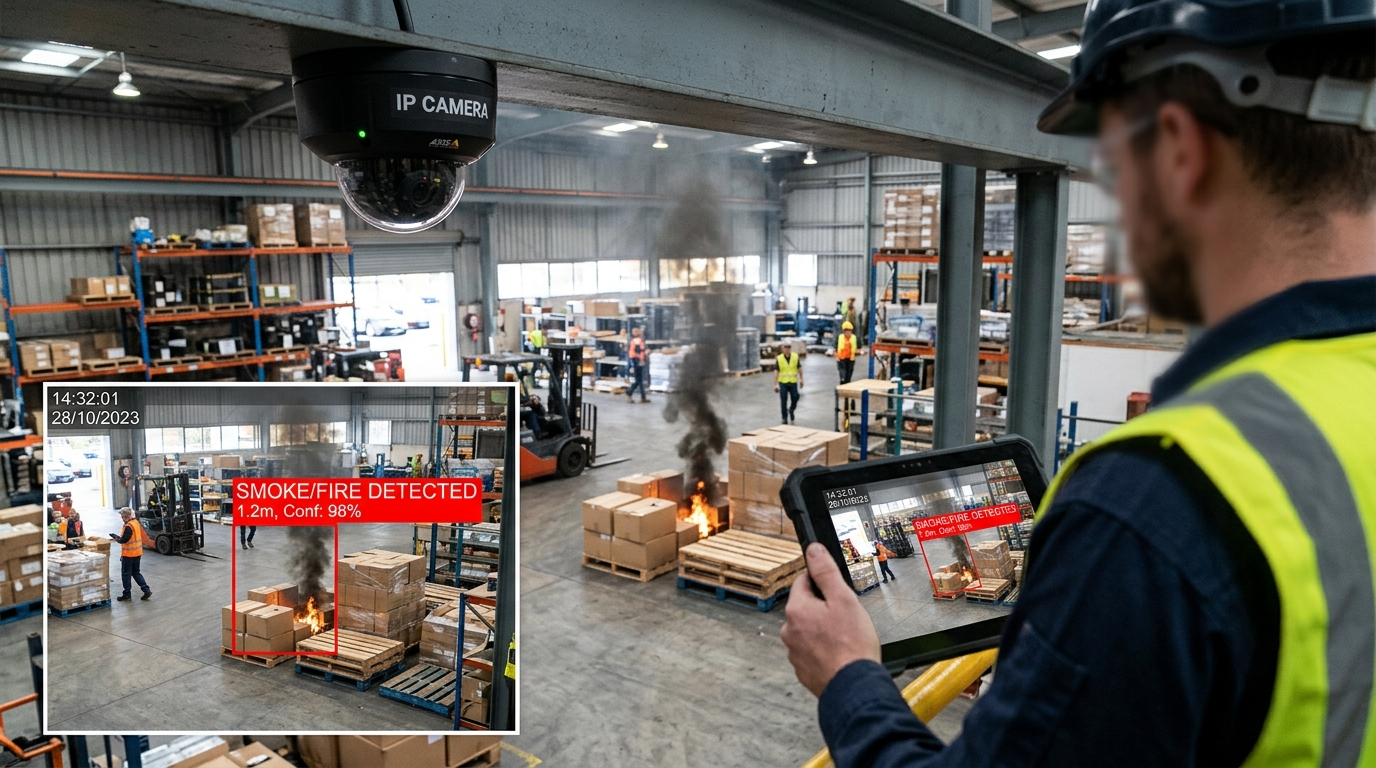
AI-Powered Fire and Smoke Detection through Cameras
The Camera-Based Fire and Smoke Detection System developed by M&L Technology analyzes video feeds from standard IP security cameras using artificial intelligence and computer vision to identify visible fire and smoke indicators at an early stage.
In addition to conventional sensors that must wait for smoke, heat or gas to physically reach the detection point, the system can visually analyze events inside the camera's field of view from a distance.
When fire or smoke is detected, real-time alerts can be delivered to registered users through SMS, automated telephone calls, email and other business-specific channels.
The solution can be customized for factories, warehouses, production sites, energy facilities, parking areas, forests, agricultural land and other indoor or outdoor environments.
Early Warning with Standard IP Cameras
The system can be designed to operate with standard IP cameras providing suitable image quality.
When the existing camera infrastructure is technically sufficient, feeds can be transferred to a centralized AI server for analysis.
This allows existing security cameras to support visual fire and smoke early-warning applications.
Camera resolution, viewing angle, mounting height, area size, night performance, lighting and network infrastructure are evaluated during field analysis.
Fire Detection
The AI model can analyze flame shape, color, movement, brightness changes and time-based behavior.
Custom detection models can be prepared for events ranging from small flames to fires spreading across a large area.
Flame-like light, reflections, welding operations and moving illumination can be included in field training data to reduce false alarms.
Smoke Detection
Smoke may appear before visible flames during the early stages of a fire.
The system can analyze smoke shape, density, direction, spreading behavior and visual differences from the background.
In wide areas or high-ceiling facilities, smoke may take time to reach conventional detectors. Camera-based analysis can evaluate visible smoke from a distance.
Steam, dust, fog, exhaust and normal process emissions may require project-specific training to distinguish them from fire smoke.
Real-Time Video Analysis
Live feeds from cameras are analyzed in real time through a centralized processing server.
Different detection zones, sensitivity levels and alarm rules can be configured for every camera.
The model can evaluate fire or smoke indicators across multiple frames to prevent brief visual changes from generating an immediate alarm.
Early Detection Benefits
One of the primary objectives of the system is to identify visible indicators as early as possible.
In large warehouses, factories, forests and outdoor locations, a camera can observe a wider area than a sensor located at a single point.
Early alerts can help security personnel verify the image, reach the area and start emergency procedures more quickly.
Reducing False Alarms
Sunlight, vehicle headlights, reflections, steam, dust, fog, welding sparks and industrial processes may create false alarms.
The AI model is tested and improved using images from the actual operating environment.
False-alarm examples can be added to the training dataset so the system learns to evaluate the same conditions more accurately.
Time-based movement and shape analysis can be used instead of relying on a single video frame.
Alarm Verification
The system can apply verification steps before raising a critical alarm.
Additional conditions may include persistence over time, increasing detection area, confirmation by a second camera or matching temperature data from a thermal camera.
In operator-confirmed configurations, the event image is sent to the monitoring center for visual review.
SMS Alerts
Automatic SMS messages can be sent to registered users after fire or smoke detection.
Messages may include facility, camera, zone, event type, date and time.
Different templates can be configured for technical teams, security personnel, managers and emergency coordinators.
Automated Telephone Calls
Critical alarms can trigger automatic calls to predefined telephone numbers.
A voice message can provide the facility, zone and camera information.
When the first user cannot be reached, additional responsible users can be called in sequence.
Email Notifications
Email alerts can be delivered after a fire or smoke event.
The message can include the event image, camera name, location, date, time and detection type.
A link to the event recording or management page can also be provided.
Multi-User Notification Management
Multiple alarm recipients can be defined through the management interface.
Name, telephone, email, responsible facility and notification level can be stored for every user.
Users can be restricted to alarms from selected facilities, cameras or event types.
Alarm Levels
- Suspicious image
- Pre-alarm
- Confirmed smoke
- Confirmed fire
- Critical spreading alarm
Different notification and response procedures can be assigned to every level.
Event Image and Video Recording
An image can be stored automatically when an alarm occurs.
A video clip covering a defined period before and after the event can also be saved.
Camera, facility, date, time, event type, confidence score and user response can be associated with the record.
Centralized Management Dashboard
All cameras, alarm records and notification results can be monitored from a web-based management dashboard.
The dashboard can show camera connectivity, last analysis time, active alarms, event history and notification results.
Users can filter by facility, camera, date, alarm type and result.
Live Camera Monitoring
Authorized users can watch live camera feeds through the management panel.
The detected fire or smoke region can be marked with a frame or visual mask.
The operator can verify the event, mark it as a false alarm or start emergency procedures.
Existing Security Camera Integration
The system can obtain video from existing IP cameras through RTSP and other supported protocols.
Depending on VMS and recorder capabilities, live streams can be transferred to the AI analysis server.
Resolution, frame rate, compression and viewing angle are evaluated for AI suitability.
Factory and Production Applications
Machinery, electrical panels, raw-material areas, painting sections, welding zones and storage areas can be monitored.
Steam, dust, sparks and process emissions can be included in training data to reduce unnecessary alarms.
Different sensitivity and alarm-duration rules can be configured for critical areas.
Warehouse and Logistics Areas
Cameras in high-ceiling warehouses can observe large pallet and shelving areas.
Early smoke indicators can be analyzed in locations storing cardboard, plastic, textile, chemical and combustible products.
Warehouse personnel, security teams and managers can be notified simultaneously.
Forest Fire Detection
The M&L Technology algorithm can be customized to analyze visible fire and smoke indicators across large forest areas.
Video from fixed and moving cameras installed on observation towers can be processed through a centralized server.
Distant smoke columns can be evaluated according to color, shape, movement and spreading behavior.
Observation Tower Integration
Cameras installed on forest and wide-area observation towers can be added to the system.
PTZ cameras can move automatically across predefined patrol routes.
When suspicious smoke is found, the camera can focus on the relevant area for closer analysis.
Drone Video Analysis
Live or recorded video from drones can be analyzed by the AI system.
Drones can patrol high-risk areas and collect images across wide regions.
When fire or smoke is detected, the image, drone location and flight time can be recorded.
Satellite Image Analysis
Large fire and smoke areas visible in suitable satellite images can be analyzed through AI.
Satellite analysis can support periodic monitoring of large geographical regions and post-event assessment.
Because image refresh rate and resolution may limit real-time capability, satellite analysis should be considered complementary to field cameras.
Agricultural and Outdoor Applications
Agricultural fields, product warehouses, hay storage and outdoor facilities can be monitored through fixed cameras.
Fire indicators during harvesting, dry-weather conditions and machinery operation can be analyzed visually.
Energy and Solar Plants
Fire and smoke indicators in solar plants, transformer areas and energy-distribution locations can be monitored.
Panels, inverter regions, cable routes and transformer surroundings can be covered by different cameras.
Thermal-camera integration can support visual detection with high-temperature alarms.
Parking and Enclosed Areas
Smoke and flame caused by vehicles can be analyzed in indoor and outdoor parking areas.
Exhaust, headlights, reflections and vehicle movement are evaluated as potential false-alarm sources.
Thermal Camera Integration
While an RGB camera analyzes visible flame and smoke, a thermal camera can measure temperature increases in the same region.
Confirmation by both systems can help reduce false alarms.
Visual smoke detection and thermal hotspot detection can be combined in one platform.
NetRelay IoT Integration
When fire or smoke is detected, commands can be sent to NetRelay through HTTP, MQTT, WebSocket or TCP.
Warning lights, sirens, ventilation, doors, barriers and auxiliary alarm equipment can be controlled through NetRelay relays.
Fire-panel, door-contact, emergency-button and sensor states can be collected from digital inputs.
Critical fire-safety functions must be performed through certified systems and control equipment meeting applicable standards.
PLC and SCADA Integration
Fire and smoke results can be transferred to PLC and SCADA platforms.
The alarm can support controlled production shutdown, warning activation and visualization of the affected zone.
Fire Alarm Panel Integration
The camera-based system can operate as an additional early-warning and visual-verification layer for a certified fire-alarm system.
Camera alarms can be associated with zone alarms, smoke detectors and temperature-sensor information from the panel.
VMS and Security Center Integration
Alarm events can be transferred to the existing video-management system or security operations center.
The relevant live camera feed can appear automatically on the operator screen after detection.
Map-Based Alarm Display
For projects containing multiple cameras and facilities, alarms can be displayed on maps and floor plans.
Users can quickly identify the relevant facility, building, floor, department and camera region.
Multi-Camera Management
Multiple camera feeds can be analyzed through one centralized server.
Cameras can be grouped by facility, department, risk level and application.
Different models, sensitivity values and schedules can be defined for every camera.
On-Premise Deployment
The system can run on a local business server when camera feeds should remain inside the facility.
Image analysis, alarm generation and recording can be performed within the local network.
Only notifications and summary reports need to be transferred externally.
Cloud and Hybrid Deployment
Cloud or data-center infrastructure can be used when cameras from multiple facilities must be managed centrally.
In a hybrid system, analysis runs locally while alarms and summary information are transferred to a centralized cloud dashboard.
AI Model Training
Fire, smoke and normal operating images that may create false alarms are collected during the project.
Images can be labeled as fire, smoke, steam, dust, fog, reflection, welding and normal operation.
Training and test datasets are separated to evaluate performance on previously unseen images.
Field Testing and Pilot Deployment
A pilot can be performed on selected cameras and zones before full deployment.
Performance is measured under different times, weather conditions, lighting levels and normal business activities.
Correct detections, missed events, false alarms, notification time and system stability are evaluated.
Event History and Reporting
Fire, smoke, pre-alarm and false-alarm events can be stored.
Reports can include facility, camera, date, event type, alarm duration, notification result and user response.
Monthly event quantities, camera performance and false-alarm rates can be analyzed.
System Health Monitoring
Camera disconnection, frozen images, covered lenses and unavailable analysis services can be monitored.
A technical alarm can be generated when no image is received for a defined period.
Server CPU, GPU, disk and network usage can be displayed.
Escalation Workflow
When the first responsible person does not respond within a defined period, the alarm can be escalated to another user.
SMS, calls and email can be used together for critical alarms.
Alarm viewing, acknowledgement and response information can be recorded.
Example Factory Scenario
IP cameras in a production area are analyzed continuously by the AI server.
When smoke appears around a machine, the system creates a pre-alarm.
If the smoke continues or the detected area increases, the alarm is confirmed.
SMS and email are sent to the security team and the relevant live camera appears on the monitoring screen.
A warning light and siren can be activated through NetRelay while authorized personnel begin emergency procedures.
Example Forest Scenario
A PTZ camera on an observation tower scans the forest through a predefined route.
The AI detects a distant smoke column and marks it in the video.
The camera zooms toward the region and the event is analyzed again across multiple frames.
The confirmed alarm is sent with camera location and direction information.
Example Warehouse Scenario
Cameras in a high-ceiling warehouse monitor pallet and shelving areas.
When a small smoke formation appears behind a shelf, the system generates a pre-alarm.
The image is transferred to the security center and warehouse personnel receive an SMS.
A critical procedure can begin after confirmation from a thermal camera or fire-alarm panel.
Frequently Asked Questions
Does the system work with standard security cameras?
Yes. Standard IP cameras providing suitable resolution, viewing angle and stream access can be used. Existing cameras are reviewed before implementation.
From what distance can it detect fire and smoke?
Detection distance depends on camera resolution, lens, viewing angle, event size, weather and lighting. The effective distance is determined through field testing.
Can it replace smoke detectors?
No. The system does not replace certified fire-detection and alarm equipment. It should be used as an additional early-warning, wide-area monitoring and visual-verification layer.
Can the system send alerts?
Yes. Registered users can receive SMS, automated telephone calls, email and other business-specific notifications.
Can it be used in forests?
Yes. Forest early-warning projects can be developed using observation towers, fixed cameras, PTZ cameras and drone footage.
How are false alarms reduced?
Steam, dust, fog, reflections, welding and normal process images are added to training data. Time-based analysis and secondary camera or sensor verification can also be used.
Can multiple facilities be monitored centrally?
Yes. Cameras from different locations can be combined through local, cloud or hybrid architectures.
Measurable Success Indicators
- Monitoring large areas through existing IP cameras
- Real-time analysis of visible fire and smoke indicators
- Supporting earlier event identification
- Automatic SMS, telephone and email notifications
- Storage of alarm images and video clips
- Adaptation to factories, warehouses, forests and outdoor areas
- Improvement through false-alarm training examples
- Integration with VMS, PLC, SCADA and security platforms
- Central management of multiple cameras and facilities
- Monitoring of alarm-response times
- Automatic monitoring of camera and system faults
- An additional visual early-warning layer for fire safety
Why Camera-Based Fire and Smoke Detection?
Conventional sensors detect smoke, heat or gas changes at a particular point. Cameras can continuously observe a much wider area.
AI-powered video analysis can visually evaluate distant smoke or flame before it physically reaches a detector.
The ability to use existing cameras, verify alarms visually and provide centralized notifications makes the system a complementary component of fire-safety infrastructure.
Important Safety Notice
The Camera-Based Fire and Smoke Detection System must not replace certified fire detectors, fire-alarm panels, extinguishing systems or legally required fire-safety measures.
It should be considered an additional solution for visual early detection, wide-area monitoring and alarm verification.
Critical functions such as evacuation alarms, power isolation and fire suppression must be performed through certified systems meeting applicable standards.
A Fire and Smoke Detection Project Customized for Your Facility
Every facility has different camera infrastructure, risk areas, viewing distances, environmental conditions and emergency procedures.
Before implementation, camera locations, monitored zones, normal operating images, false-alarm sources, notification recipients and integration requirements are analyzed.
A pilot can begin with selected cameras and areas. After fire and smoke detection, false-alarm rates, notification times and system stability are validated, the solution can be expanded across the facility.
For detailed information, visit the Camera-Based Fire and Smoke Detection project page.
Community
Comments and questions
Nothing has been published yet.