The M&L technology approach
Computer Vision
We analyze camera feeds to deliver measurable results in production counting, quality inspection, object detection and field safety processes.
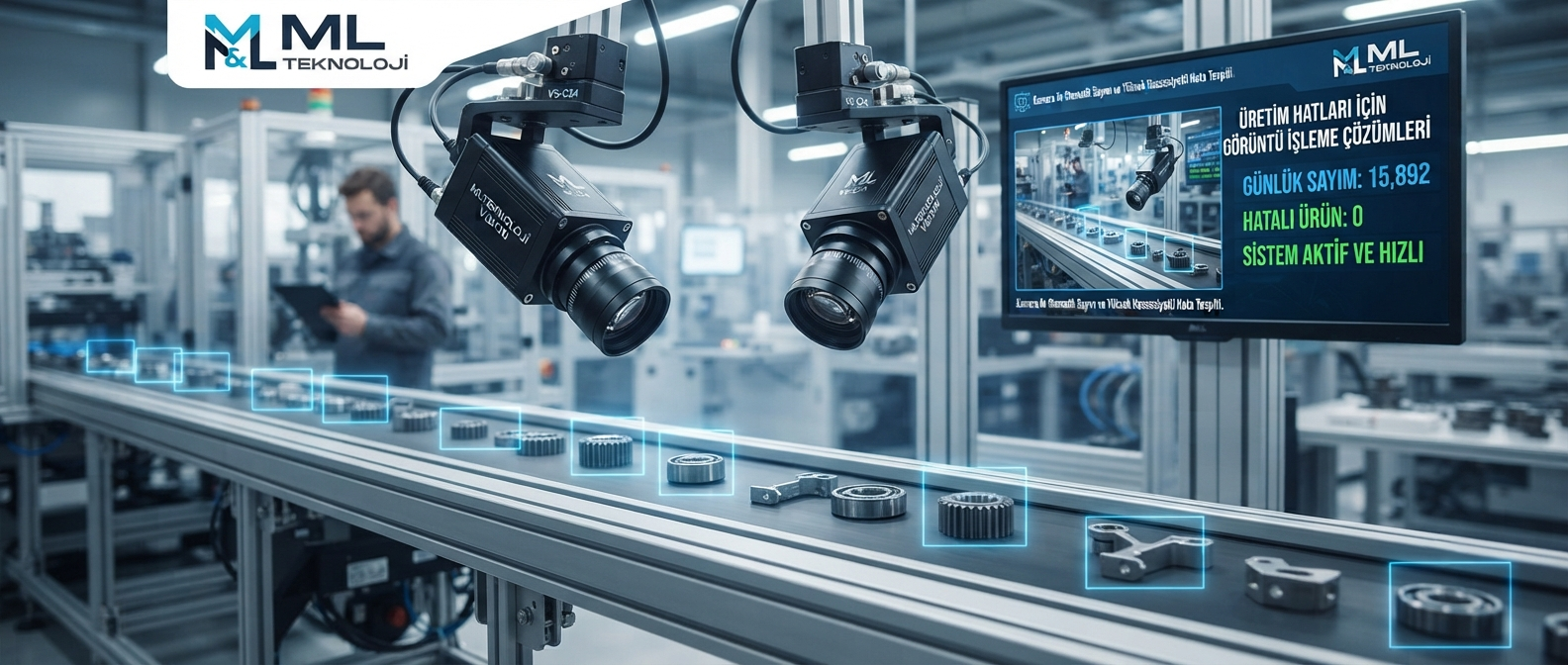
Transforming Camera Feeds into Measurable Data
At M&L Technology, we develop customized computer vision solutions for production facilities, factories, warehouses, logistics centers, technical areas and outdoor field applications.
Images obtained from optical, industrial or thermal cameras are analyzed in real time using artificial intelligence algorithms. Products, people, vehicles, machinery and business-specific objects can be automatically detected, classified, counted and tracked.
This transforms cameras from passive recording devices into intelligent data sources that continuously monitor production, quality, safety and operational processes.
Real-Time Object Detection
Our computer vision system detects objects within live camera feeds in real time. Customized AI models can be developed for people, vehicles, boxes, packages, pallets, products, production components, machinery, personal protective equipment and other business-specific objects.
The system can analyze more than the presence of an object. Its location, direction of movement, speed, time spent within a defined area and relationship with other objects can also be measured.
Detected objects can be tracked with unique identities, preventing the same product, person or vehicle from being counted multiple times.
Automated Product Counting on Production Lines
Manual counting operations may cause lost time, inconsistent records and human error.
A camera installed at a suitable position on the conveyor automatically detects and counts products moving through the production line. Customized tracking algorithms can be applied when products move close together or in different directions.
Production quantities can be stored by product, machine, line, shift, operator and date. Actual production can be compared with planned targets in real time.
The system can automatically generate notifications when production speed falls below the target or when no product passes through the inspection point for a predefined period.
AI-Powered Quality Inspection
Computer vision systems make it possible to detect quality problems automatically during production.
Product shape, dimensions, color, surface condition, assembly status, label position and packaging quality can be inspected through camera images.
Customized inspection models can be developed for missing components, incorrect assembly, breakage, cracks, deformation, surface defects, color differences, incorrect labels and unsuitable packaging.
When a defective product is detected, its image is stored together with the date, time, production line, product type and defect category.
The inspection result can be shared with a PLC, NetRelay IoT controller or the existing automation system. A defective item can then be removed automatically, a warning light can be activated or an audible alert can be generated.
Label and Packaging Verification
The presence, position, orientation and compliance of product labels can be inspected through computer vision.
Incorrect labels, missing labels, misalignment, unclosed boxes and unsuitable packaging conditions can be detected automatically.
For suitable projects, the solution can be combined with barcode, QR code or optical character recognition technologies. Read values can be compared with production orders, product records or reference information stored in the database.
Restricted-Area and Virtual-Zone Monitoring
Virtual inspection zones can be created within camera images to monitor whether people, vehicles or specified objects enter restricted areas.
Areas around production machinery, forklift routes, electrical rooms, warehouses, loading zones and authorized-personnel areas can be monitored automatically.
When unauthorized access or unsafe proximity is detected, the system can generate an alarm, notify responsible personnel and store the related event image.
Occupational Health and Safety Monitoring
The system can automatically verify whether employees are using safety helmets, reflective vests, protective glasses and other project-specific personal protective equipment.
When a safety violation is detected, the image can be stored, an operator warning can be generated or a notification can be sent to the occupational safety team.
This allows risky situations to be identified more quickly without requiring safety personnel to monitor all camera feeds continuously.
People, Vehicle and Machinery Tracking
People, vehicles, forklifts and other moving equipment can be detected and tracked separately within camera feeds.
The number of people or vehicles passing through an area, movement direction, traffic density and waiting time can be analyzed.
This capability can be used at factory entrances, loading areas, parking facilities, warehouses and logistics centers.
License Plate Recognition and Vehicle Access
Vehicle license plates can be read through camera images and compared with authorized vehicle lists stored in the database.
Authorized vehicles can be granted automatic access, while unknown vehicles can generate security notifications or require manual approval.
Vehicle entrance and exit records can be stored with the date, time, camera, license plate and access-point information.
Fire, Flame and Smoke Detection
AI-powered computer vision solutions can analyze camera feeds for smoke, flame and abnormal visual changes in real time.
The system can support early detection of fire indicators in factories, warehouses, production facilities, agricultural areas and outdoor environments.
When smoke or flame is detected, an alarm can be generated, image-based notifications can be sent and the event can be transferred to a central management platform.
Camera-based fire detection can be used as an additional safety layer supporting existing fire detection and alarm systems.
Thermal Camera Analysis
Thermal cameras visualize the heat energy emitted by objects and provide important information in conditions where standard cameras may be insufficient.
Thermal computer vision solutions can detect overheating in machinery and electrical panels, monitor product temperatures and identify abnormal temperature changes.
When predefined temperature limits are exceeded, the system can automatically generate an alarm, activate ventilation or request an inspection of the production line.
Machine Status and Downtime Analysis
Movement on the production line can be analyzed to determine whether machinery is operating, whether product flow has stopped or whether congestion has occurred at a specific point.
If product movement stops for a predefined period, the event can be marked as unplanned downtime. The operator may be asked to select a downtime reason, and the event can be included in production reports.
Camera data can be combined with information collected from PLCs, sensors and NetRelay digital inputs to create more reliable operation and downtime records.
Automated Field Actions with NetRelay
Events detected by the computer vision system can be transferred to a NetRelay IoT controller.
NetRelay relay outputs can control warning lights, sirens, fans, pumps, barriers, door locks and product separation mechanisms.
For example, when a defective product is detected, the system can activate a red warning light and trigger a pneumatic separator. When a person enters a restricted area, an audible alarm can be activated. When excessive temperature is detected, ventilation can be started automatically.
Communication methods such as HTTP, MQTT, WebSocket and TCP can be used for real-time data exchange between the AI software and field devices.
Centralized Management and Reporting Dashboard
All camera and analysis results can be monitored through a web-based centralized management dashboard.
Live camera feeds, detected objects, production counts, defective products, area violations, alarm records and system status can be displayed through the same interface.
Records can be filtered by camera, date, shift, product, production line, defect category or event type.
Daily, weekly and monthly reports can be generated automatically and delivered to authorized users in Excel or PDF format.
ERP and Production Software Integration
Production and quality information generated by the computer vision system can be transferred to the existing ERP or production management software.
Production orders can be imported from the ERP system, while actual production, scrap, defects and downtime can be linked to the relevant order.
Integration can be implemented through REST APIs, SQL Server, PostgreSQL, MySQL, Oracle, JSON, XML, CSV or other methods supported by the company's infrastructure.
Controlled Camera and Field Networks
Secure and controlled network access is important in environments containing cameras and field devices.
Cameras, AI servers, IoT devices and operator terminals can be configured in separate network segments according to project requirements.
When controlled internet access is required for field personnel, technical teams or visitors, IDNet hotspot and network-management solutions can be included.
User authentication, access-duration management and centralized network control can be provided through MikroTik, UniFi, Ruijie Cloud and Grandstream infrastructures.
Automated Notifications
The system can automatically send notifications when production falls behind target, a defective product is detected, an area violation occurs, machinery stops, a fire indicator is identified or camera connectivity is lost.
Notifications can be delivered to production, quality, maintenance or security teams through email, SMS or mobile applications.
Notification rules can be configured according to event type, priority, production line and user authorization.
Example Production-Line Application
On a packaging line, an IP camera detects products moving along a conveyor and counts each item only once.
The AI model checks whether the product cover is closed, whether the label is correctly positioned and whether there is visible damage to the packaging.
Accepted products are added to the production count. When a defective item is detected, the system stores its image, identifies the defect category and triggers a pneumatic separator through a NetRelay relay to remove the item from the line.
When the defect count exceeds a predefined threshold, a notification is sent to the quality manager. At the end of the day, total production, accepted products, defective products, defect categories and downtime are reported automatically.
Example Field-Safety Application
In a warehouse where forklifts operate, safe pedestrian corridors and hazardous vehicle zones are defined within the camera image.
When an employee enters a hazardous vehicle zone or when the distance between a forklift and a person falls below a critical level, the system generates an alarm.
A warning light and audible alert can be activated through NetRelay. The event image is added to occupational safety records with the date and time.
Measurable Success Indicators
- Reduced manual product-counting errors
- Real-time production visibility
- Earlier detection of defective products
- Standardized quality inspection processes
- Measurement of defect categories and recurrence rates
- Automatic identification of unplanned downtime
- Recording of area violations and safety events
- Automated physical actions for critical events
- Transfer of production and quality information to ERP systems
- Reduced manual inspection and reporting time
Business Benefits
Computer vision solutions transform processes previously inspected only by people into measurable and reportable operations.
Production, quality and safety information is combined within one central platform, helping managers make decisions based on actual field data.
Recurring quality problems, production bottlenecks, congestion, downtime and safety risks become more visible.
The system can begin with a single camera and inspection point and scale by adding new production lines, cameras, AI models and automation devices.
A Computer Vision Project Customized for Your Business
Every production line, product and working environment has different visual characteristics. Camera angle, lighting, product speed, background, environmental conditions and the required accuracy directly affect project success.
A field analysis is therefore conducted before development begins. Camera positions, inspection points, sample images, integration requirements and measurable success indicators are defined.
A customized AI model is trained with images collected from the actual working environment. The system is tested under real production conditions and improved according to the results.
For further information about artificial intelligence, computer vision and production software, visit M&L Technology. For field devices, sensors and automated relay control, visit NetRelay. For controlled network access and hotspot solutions, visit IDNet.