The M&L technology approach
Production Automation
We combine machinery, PLC, sensor, camera and enterprise software data to build systems that monitor and manage production processes in real time.
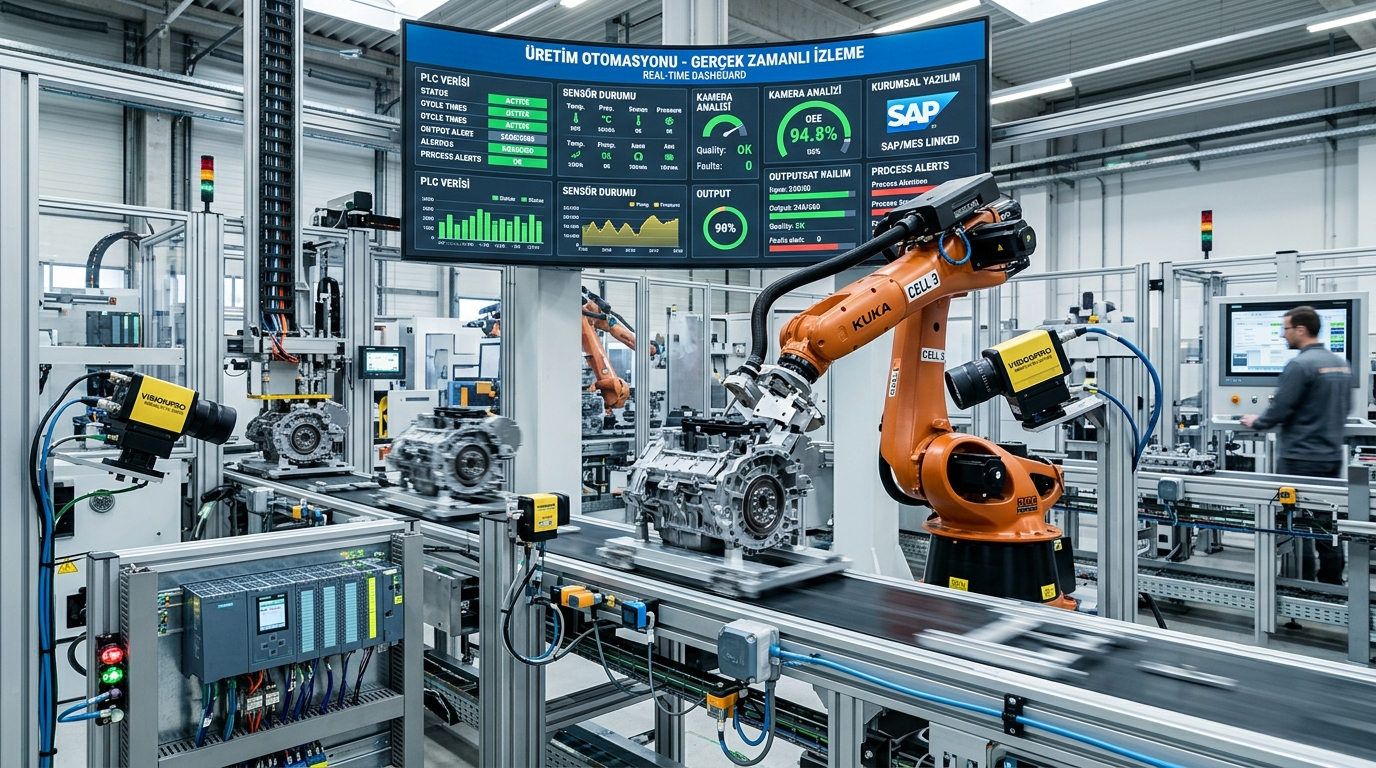
Make Your Production Processes Intelligent and Measurable
At M&L Technology, we develop production automation solutions tailored to the operational structure of factories and manufacturing facilities.
We combine data collected from machinery, PLC systems, sensors, cameras and operator interfaces within one centralized software platform. Production quantity, machine status, downtime, fault information, quality results and target achievement rates can be monitored in real time.
The system does more than collect field data. Machinery, warning lights, sirens, product separation mechanisms, fans, pumps and other field equipment can be controlled automatically according to predefined conditions.
This reduces manual data entry, improves production visibility and allows managers to make decisions based on actual field information.
What Is Production Automation?
Production automation is the combination of machinery, sensors, control devices and software that work together according to defined manufacturing scenarios.
Data generated from the moment a product enters a production line until it is completed can be collected, inspected and reported automatically.
Production counting, machine-status monitoring, quality inspection, fault management, downtime analysis, maintenance tracking and ERP data exchange can be managed through a single automation infrastructure.
PLC and Machine Integration
Operating, downtime, fault, cycle, product acceptance and product rejection information can be collected from PLC systems on the production line.
OK and NOT OK signals generated by test and inspection devices can be stored in the database in real time. Accepted products, rejected products, scrap and rework quantities can therefore be monitored separately.
Counters, sensors and status information available on the PLC can be transferred to the production software. Depending on project requirements, production orders, recipes and operating parameters prepared in the software can also be sent to the PLC.
When modification of the existing PLC program is not suitable, dry contacts, digital outputs, serial communication or independent data-collection devices can be used.
Real-Time Production Counting
Production quantities can be determined automatically through PLC signals, photoelectric sensors, inductive sensors, push buttons, counter outputs or camera-based computer vision systems.
Each production signal is stored together with the date, time, machine, production line, product and shift information.
Data collected from multiple machines or production lines can be combined in the same central system. Managers can view total factory output or the performance of each individual line.
Reducing manual counting helps prevent inconsistent records and human counting errors.
Production Targets and Efficiency Monitoring
Standard cycle time, shift target, hourly output target and total planned quantity can be defined for each product.
The system automatically calculates the quantity that should have been produced according to elapsed time and compares it with actual production.
Line displays can show target production, actual output, remaining quantity, hourly speed, efficiency percentage and estimated completion time.
When production speed falls below the expected level, an automatic notification can be sent to the operator or production manager.
Andon and Production-Line Displays
Televisions, industrial panels or kiosk displays installed in production areas can show the current status of each line.
Displayed information may include the current product, production order, target quantity, actual output, accepted products, rejected products, downtime and shift performance.
Visual status indicators such as green for operating, yellow for planned downtime and red for faults can be used.
Line displays help operators monitor current targets and respond more quickly to production problems.
Machine Operation and Downtime Monitoring
Signals received from PLCs or sensors can be used to calculate machine operating, waiting, planned downtime and fault durations automatically.
When no production signal is received for a specified period, the system can create a possible downtime record. The operator can then select or enter a downtime reason.
Material shortage, product changeover, mould change, breaks, cleaning, quality approval, maintenance and unplanned faults can be reported separately.
Downtime frequency and total duration can be analyzed to identify the causes responsible for the greatest production losses.
Fault and Maintenance Management
Fault codes generated by machinery or PLC systems can be transferred to the centralized software.
When a fault occurs, an automatic notification can be sent to the maintenance team and a maintenance record can be created for the related machine.
The time of the fault, maintenance response time, completed work, parts used and production restart time can be recorded.
This information can be used to measure fault response time, mean repair duration, recurring fault rates and machine availability.
Preventive Maintenance and Periodic Inspections
Maintenance plans can be created according to operating hours, production quantity or calendar dates.
When a defined operating duration or production quantity is reached, the system can send an automatic reminder to the maintenance team.
Lubrication, filter replacement, mould inspection, sensor cleaning, electrical connection inspections and safety tests can be managed through digital checklists.
Completed maintenance work can be stored with personnel, date, description and material information.
Quality Control Automation
Quality inspection results can be transferred to the system from test devices, PLCs, measuring equipment or operator interfaces.
Accepted and defective quantities can be stored separately, while defects can be classified by type.
Dimensional errors, missing components, incorrect assembly, color differences, label problems, surface defects and failed tests can be defined according to business requirements.
When the quality defect rate exceeds a defined limit, a notification can be sent to the production manager or the related line can be stopped for inspection.
Automated Inspection with Computer Vision
The production automation system can operate together with AI-powered computer vision solutions.
Standard IP or industrial cameras can count, classify and track products moving through the production line.
Quality issues such as missing components, incorrect assembly, unsuitable labels, packaging defects and surface problems can be detected from images.
Accepted and defective product results generated by computer vision can be transferred to PLC systems or centralized production software.
When a defect is detected, a pneumatic separator can be triggered, the conveyor can be stopped or visual and audible warnings can be generated.
Field Control with NetRelay
The NetRelay IoT platform developed by our engineers connects production software with field sensors and electrical equipment.
Sensors, dry contacts and pulse outputs connected to NetRelay digital inputs can provide machine status, production and fault information.
Pulse signals collected through digital inputs can be processed by counters to calculate production speed and total output.
Relay outputs can control warning lights, sirens, fans, pumps, motor contactors, barriers, door locks and product separation mechanisms.
HTTP, MQTT, WebSocket and TCP communication methods can transfer field information to the centralized software and send real-time control commands to devices.
Sensor and Environmental Monitoring
Temperature, humidity, pressure, current, voltage, vibration, water level and similar production-environment values can be monitored through sensors.
Measurements can be associated with production records, making it possible to analyze relationships between environmental conditions, quality problems and equipment failures.
When predefined limits are exceeded, the system can generate automatic alarms. Scenarios such as activating ventilation when temperature rises or starting a pump when the water level falls can be implemented.
Energy and Consumption Monitoring
Electricity, water, compressed air and other consumption values can be collected for production lines and individual machines.
Energy consumption per product, shift-based consumption and machine-level usage can be calculated.
Machines consuming excessive energy while not producing or departments operating above expected consumption levels can be identified.
This information can support energy-efficiency projects and more accurate production-cost calculations.
OEE and Performance Analysis
Machine availability, performance and quality data can be combined to calculate overall equipment effectiveness indicators.
Planned production time, operating time, downtime, ideal cycle time, total production and accepted-product quantities can be analyzed automatically.
OEE results can be compared by machine, production line, product, shift and date.
This makes it easier to determine whether production losses originate from availability, speed or quality.
Production Order and Recipe Management
The product, target quantity, planned start and completion times, assigned machinery and production recipe can be defined through the system.
Production orders can be created manually by authorized users or imported automatically from an ERP platform.
The operator can select the correct production order from the line display. Barcode or QR code verification can help prevent the selection of an incorrect product or recipe.
When production is completed, actual output, scrap, quality results and operating times are linked to the relevant production order.
ERP and Enterprise System Integration
The production automation platform can integrate with Logo Tiger and similar ERP, accounting, inventory and enterprise-management systems.
Product records, production orders, recipes, inventory information, sales orders and production plans can be imported from the ERP system.
Actual production, accepted quantities, scrap, defects, consumed materials and downtime can be transferred back to the ERP platform.
Integrations can be implemented through REST APIs, SQL Server, PostgreSQL, MySQL, Oracle, XML, JSON, CSV, Excel or other data-transfer methods supported by the organization.
Barcode, QR Code and RFID Applications
Barcode, QR code and RFID technologies can be used to track raw materials, semi-finished products, finished products, containers and pallets throughout production.
Before production begins, the operator can scan the production order and required materials. The system can verify the correct combination of product and material.
When production is completed, product labels can be generated and printed automatically.
Product movements can be traced from raw material to shipment, improving historical traceability.
Operator and Personnel Performance
Production information can be associated with shift and operator records.
The lines operated, production quantities, quality results and downtime records can be reported according to user authorization.
This information should not be used only to evaluate employees by output. It can also support analysis of training requirements, process differences and operating conditions.
The use of personnel-based data can be restricted according to company policies and applicable regulations.
Centralized Production Management Dashboard
All machinery, production lines and field devices can be monitored through a centralized web-based dashboard.
The dashboard can show operating lines, stopped machines, active faults, production quantities, quality results, target achievement rates and sensor measurements.
Data can be filtered by factory, department, production line, machine, product, shift and date.
Different interfaces and permissions can be assigned to management, production, quality, maintenance and operator users.
Mobile Access and Remote Management
Authorized users can access production status from desktop computers, tablets and mobile devices.
Managers can monitor production quantities, downtime and critical alarms while outside the factory.
According to security requirements, remote-control functions can be enabled only for specific users or within the local company network.
Automated Notifications
Automatic notifications can be sent for unplanned downtime, production-target deviations, high defect rates, sensor alarms, maintenance requirements and device connection failures.
Notifications can be delivered to relevant personnel through email, SMS or mobile applications.
Different priority levels, user groups and repetition rules can be defined for each event.
Non-critical events can be included in reports, while urgent conditions can generate immediate notifications.
Automated Reporting
Daily, weekly and monthly production reports can be generated automatically by the system.
Reports can include planned and actual production, accepted products, scrap, defect rates, operating time, downtime, fault causes and efficiency indicators.
Reports can be created in Excel or PDF format and delivered automatically to authorized users.
Business-specific charts, summary tables and management indicators can be developed.
Controlled Factory and Guest Networks
PLCs, cameras, IoT devices, servers and operator terminals should operate within a secure network infrastructure.
Production equipment, corporate users and guest internet access can be configured within separate network segments.
When controlled internet access is required for technical service teams, visitors or temporary personnel, IDNet hotspot and network-management solutions can be included.
User authentication, access-duration control and centralized network management can be provided through MikroTik, UniFi, Ruijie Cloud and Grandstream infrastructures.
Example Production Automation Application
On an assembly line, the product and target quantity are transferred from the ERP platform to the centralized production software. The operator selects the related order from the line interface and begins production.
Cycle, OK and NOT OK signals generated by the PLC are stored in the database in real time. The display shows target production, actual output, rejected products and current efficiency.
A camera system checks whether all required components have been assembled correctly. When a defect is detected, its image is stored and a separation mechanism is activated through a NetRelay relay.
If the production signal stops for three minutes, the system creates a downtime record and asks the operator to select a reason. When a fault is selected, an automatic notification is sent to the maintenance team.
At the end of the shift, total production, quality results, downtime and fault durations are reported automatically. Actual output is transferred to the related ERP production order.
Measurable Success Indicators
- Real-time monitoring of production quantities
- Reduced manual data entry
- Instant comparison of planned and actual production
- Measurement of unplanned downtime and its causes
- Calculation of machine operating and waiting times
- Monitoring of scrap and quality defect rates
- Measurement of maintenance response and repair times
- Automatic transfer of production information to ERP systems
- Automated notifications for operational problems
- Automatic control of field equipment according to predefined rules
- Improved product and batch traceability
- Automatic preparation of production reports
Benefits of Production Automation
Production automation reduces the difference between actual field conditions and the information available in management systems.
Managers can clearly see where production slows down, which machines stop more frequently, which products generate more defects and how closely targets are achieved.
Reducing repetitive manual operations allows employees to focus more on inspection, improvement and production activities.
The system can begin with a single production line and expand with additional machinery, sensors, cameras, reports and automation scenarios.
A Solution Designed for Your Production Facility
Every factory has a different machine structure, production method, PLC infrastructure, data source and quality requirement.
A field analysis is therefore conducted before development begins. Existing machinery, PLC models, signal points, production workflows, user roles and integration requirements are identified.
A pilot production line can be selected during the initial stage. After the pilot results are verified, the solution can be expanded to additional lines and factories.
For further information about production automation, artificial intelligence, computer vision and custom software, visit M&L Technology. For sensor, digital-input and relay-based field control, visit NetRelay. For controlled internet access and hotspot solutions, visit IDNet.