The M&L technology approach
Smart Field Production and Efficiency System
Manage production counting, quality inspection, downtime tracking and automated field actions from a single platform with AI solutions that deliver measurable results.
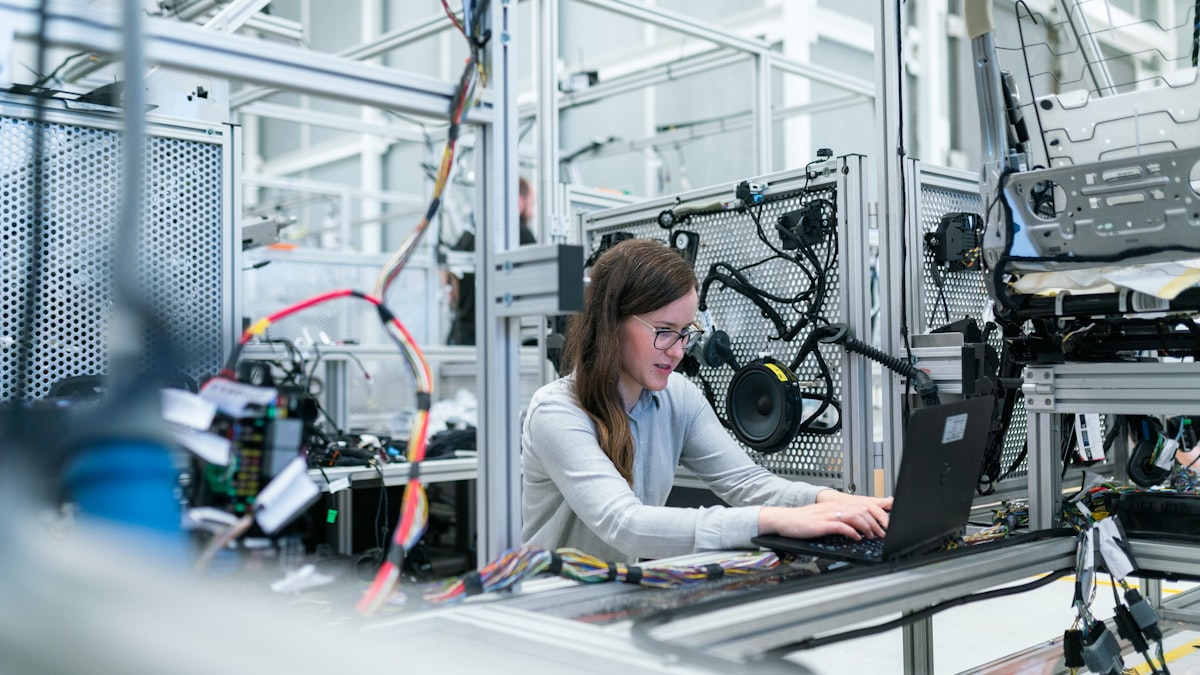
AI Solutions That Deliver Measurable Results in the Field
The Smart Field Production and Efficiency System is an end-to-end artificial intelligence and Industrial IoT project designed to count products, detect production defects, monitor machine downtime and trigger automated field actions when critical events occur.
The solution brings standard IP cameras, AI-powered computer vision software, PLC systems, sensors and NetRelay IoT controllers together within one centralized platform. Data collected from the field is processed in real time, reported and converted into physical actions according to business-defined rules.
How the Project Works in the Field
An IP camera installed at a suitable point on the production line continuously monitors products moving along the conveyor. The AI model detects, classifies and counts each product in real time. Object-tracking algorithms prevent products moving close together from being counted more than once.
The system can inspect product shape, direction, color, component integrity and other project-specific quality criteria. When a defective product is detected, its image is recorded and the product can be removed through a separation mechanism controlled by a PLC or NetRelay device.
Production Counting and Target Monitoring
Total production quantities are stored by production line, machine, product, shift and date. At the beginning of a shift, the operator or production manager can select the product and define the production target.
The software continuously compares planned production with actual output. When hourly performance falls below the target, an automatic notification can be sent to the responsible manager. Line displays can show actual production, target quantity, remaining units, efficiency rate and estimated completion time.
AI-Powered Quality Inspection
The system is not limited to product counting. An AI model trained with sample images from the production environment can detect missing components, incorrect assembly, surface defects, incorrect labels, color variations and unsuitable product orientation.
Each defect is recorded with the date, time, production line, product type and related image. This makes it possible to analyze recurring defect types and identify the shifts or operating conditions in which they occur most frequently.
Machine Downtime and Fault Monitoring
Operating and fault signals received from PLCs, dry contacts or NetRelay digital inputs are used to calculate machine running, waiting and fault durations automatically.
When unexpected downtime occurs, the operator interface can request a downtime reason. Maintenance, material shortage, product changeover, quality inspection and unplanned failure can be recorded separately.
The system can also measure maintenance response time, repair duration and the exact time when production resumes.
Physical Field Control with NetRelay
The NetRelay IoT controller connects the AI software with physical field equipment. Digital inputs can read machine, door, alarm and sensor states, while relay outputs can control warning lights, sirens, fans, pumps, barriers and product separation mechanisms.
For example, when a defective product is detected, the system can activate a red warning light, generate an audible alert or trigger a pneumatic separator. When a machine produces no output for a specified period, a maintenance record can be created automatically.
NetRelay supports HTTP GET/POST, MQTT, WebSocket and TCP communication. Field data can therefore be transferred to the software while real-time control commands are sent back to connected devices.
Environmental Sensor Monitoring
Temperature, humidity, pressure, light and other environmental conditions that may affect production quality can be monitored through connected sensors. Automatic alarms can be generated when measurements move outside predefined limits.
The solution can activate ventilation when temperature rises, notify an operator when humidity reaches a critical value or associate environmental data with production and quality reports.
Centralized Web Management Dashboard
All production and field data is monitored through a responsive web-based dashboard. Users can view live production quantities, line status, quality defects, downtime, alarm records and sensor measurements.
User permissions can be assigned to managers, production supervisors, operators, quality personnel and maintenance teams. Each user can access only the authorized production lines and system modules.
ERP and Enterprise Software Integration
Production orders can be imported automatically from the existing ERP system. Actual production, scrap, defective products and downtime information can be linked to the relevant production order and transferred back to the ERP or reporting platform.
Integration can be implemented through REST APIs, SQL Server, PostgreSQL, MySQL, Oracle, JSON, XML, CSV or other methods supported by the company's existing infrastructure.
Controlled Field and Guest Network Access
When controlled internet access is required for technical service teams, visitors or temporary personnel, IDNet hotspot and network-management capabilities can be included in the project.
User authentication, access-duration management and centralized network control can be provided through MikroTik, UniFi, Ruijie Cloud and Grandstream infrastructures. User records can be imported from API, SQL, XML, JSON, CSV or Excel sources to create accounts automatically.
This component operates as an independent security layer and allows temporary users to access the corporate network in a controlled manner.
Automated Notifications and Reporting
The system can send email, SMS or application notifications when production falls behind target, a machine stops, a quality defect is detected, a sensor alarm occurs or a network connection is lost.
Daily, weekly and monthly production reports can be generated automatically. Reports may include total output, target achievement rate, defective product quantity, downtime, fault reasons and shift performance.
Measurable Success Indicators
- Reduced manual product-counting errors
- Real-time visibility into production quantities
- Earlier detection of defective products
- Measurement of unplanned downtime and its causes
- Calculation of maintenance response and repair times
- Efficiency comparison by shift, line and product
- Automatic transfer of production and quality data to ERP systems
- Automated alerts and physical actions for critical field events
Example Application Scenario
On a packaging line, a camera detects boxes moving along the conveyor and counts each box only once. The AI model checks whether the box is properly closed and whether the label is positioned correctly.
When a defective box is detected, the system stores the event image, activates a warning light through a NetRelay relay and triggers a pneumatic separator to remove the product from the line. Accepted and rejected quantities are stored in the database.
If the line produces no product for five minutes, the system identifies unplanned downtime and requests a reason from the operator. The production manager receives a notification. At the end of the day, production, scrap, quality defects and downtime are reported automatically.
Business Benefits
This project is more than an independent AI application that analyzes camera images. It is an integrated field solution connecting cameras, software, databases, IoT controllers, sensors, PLCs and existing enterprise systems.
The collected data reveals where production slows down, when quality defects increase, which machines experience the most downtime and how closely targets are achieved. Managers can therefore make decisions based on actual field data rather than assumptions.
Let Us Develop Your Project
The system can be customized according to the production line, product characteristics, camera environment, machinery and existing software infrastructure. The first stage includes a field analysis to identify camera positions, inspection points, data sources and measurable success indicators.
For further information about artificial intelligence, computer vision and production software, visit M&L Technology. For field devices, sensors and relay control, visit NetRelay. For hotspot and controlled network-access solutions, visit IDNet.