The M&L technology approach
NetSAYIM – AI Product Counting System
AI-powered production tracking system that counts, classifies and reports bags, boxes and bottles moving on conveyors using standard IP cameras. Ready for ERP, MES and PLC integration.
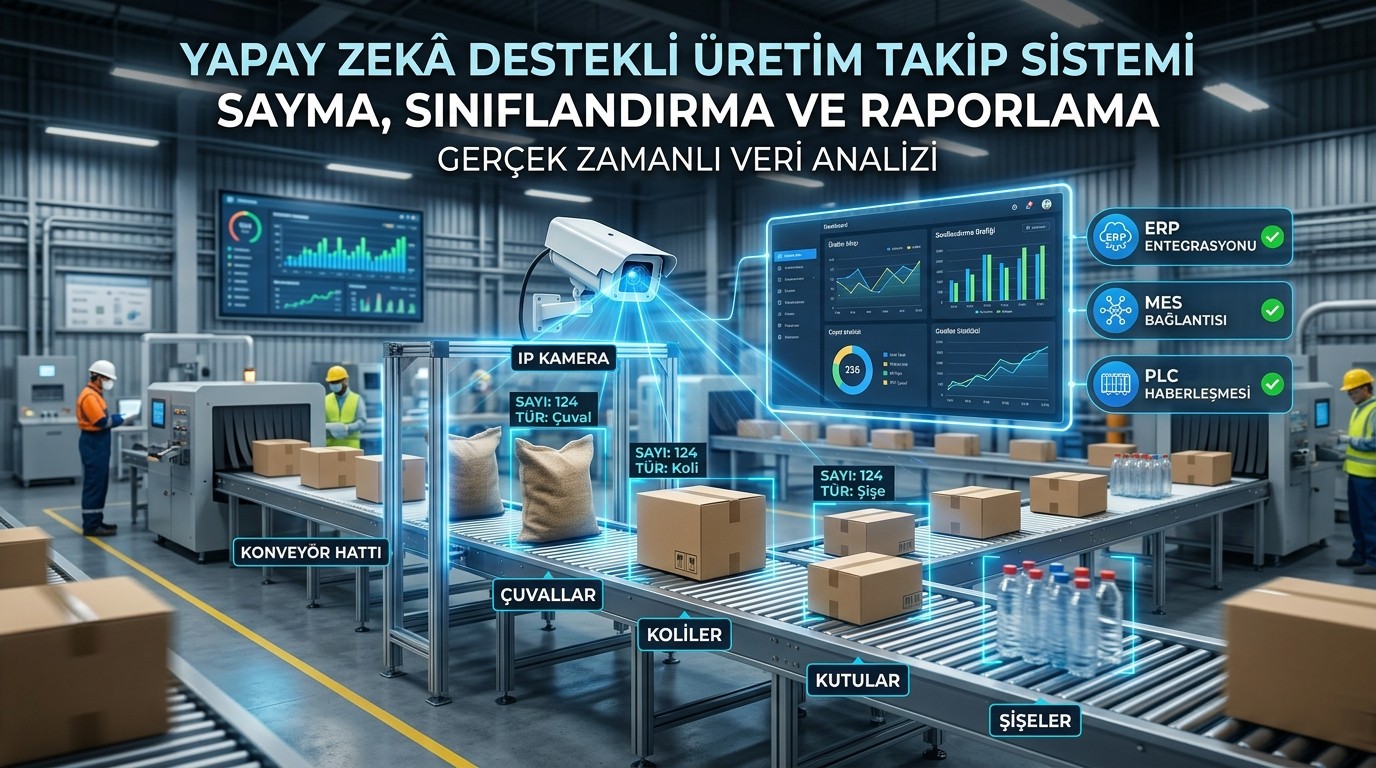
Every Product on the Conveyor, Counted by Camera and Verified by AI
How many bags actually came off the line during the last shift? How many boxes were really loaded onto the truck? In most plants the answer still lives on a tally sheet, a mechanical counter, or a spreadsheet filled in at the end of the day. NetSAYIM is an AI-powered product counting system built to remove that uncertainty. It turns an ordinary IP camera pointed at your production line into a smart sensor that detects, classifies, and records every single item passing the conveyor in real time.
The live camera feed is analysed on an Nvidia GPU-accelerated processing unit using deep learning object detection and multi-object tracking. Every item entering the field of view is assigned a unique tracking ID and added to the production counter the moment it crosses a configurable virtual counting line. The same item is never counted twice, and products that pause, drift backwards, or re-enter the frame do not inflate the total.
Bags, sacks, boxes, cartons, bottles, jars, canisters, metal parts, injection-moulded components, or an object unique to your plant — whatever needs counting, the AI model is trained on real footage captured from your own line. NetSAYIM is not an off-the-shelf counting device; it is a machine vision counting project shaped around your actual production conditions.
How Camera-Based Product Counting Works
- Image capture: A standard IP camera mounted above or beside the conveyor streams live video to the central processing unit over the local network.
- Object detection: A deep learning model detects products in every frame. Because the model is trained on your real footage, it recognises dusty, deformed, angled, and partially visible items.
- Object tracking: Each detected product receives a tracking ID and is followed across frames. This is what prevents duplicate counting.
- Virtual line crossing: When the product centre crosses the configured counting line in the defined direction, the counter increments.
- Recording and integration: Every crossing is stored with date, time, line, product, shift, operator, and work order, pushed to live screens, and forwarded to PLC and ERP systems where required.
Why AI Vision Instead of Photoelectric or Laser Sensors?
Classic photoelectric and laser counting systems work well when products travel in a single, evenly spaced row. Real production lines are rarely that tidy. Items overlap, run side by side, arrive faster than expected, or change shape — and the sensor still sees only one interruption.
| Criterion | Photoelectric / Laser Sensor | NetSAYIM (AI Camera) |
|---|---|---|
| Overlapping or side-by-side items | Counted as one | Separated as distinct objects |
| Product changeover | Requires physical re-setup | New class added to the model, same camera |
| Distinguishing product types | Not possible | Separate counter per product class |
| Visual evidence | None | Snapshot of each crossing can be archived |
| Quality inspection | None | Label, cap, packaging and deformation checks |
| Dust, vibration, misalignment | High false-trigger risk | Evaluated with full visual context |
| Reporting | Total count only | By line, product, shift, operator, work order |
Smart Counting with Standard IP Cameras
NetSAYIM's biggest practical advantage is that it runs on standard IP cameras of adequate image quality. Where existing CCTV infrastructure is technically suitable, the system goes live without investing in expensive industrial machine vision hardware.
Camera angle, resolution, frame rate, lighting, network bandwidth, and product speed are all assessed during the site survey. Where the line is fast or ambient light is inconsistent, additional lighting, a different lens, or a dust- and moisture-resistant housing is recommended.
Bag and Sack Counting Systems
Bag counting is the toughest and most requested camera counting application. Every bag leaving a filling line takes a slightly different shape: some plump, some flat, some tilted, some resting on the one before it. Photoelectric sensors miscount easily in these conditions.
Used as a bag counting system, NetSAYIM tracks each sack as an individual object and records its crossing. Touching and partially overlapping bags are separated by the tracking algorithm. It suits flour, feed, fertiliser, cement, sugar, granulate, and chemical packaging and dispatch lines. Output is reported by product, line, shift, operator, truck, or railcar — so discrepancies between loaded quantity and dispatch note are caught before the vehicle leaves the yard.
Box, Carton and Package Counting
Boxes, cartons, and packages moving through packaging and dispatch lines are counted automatically. Products of different sizes or designs are defined as separate classes, enabling per-product counting on a shared conveyor. Counting data links to warehouse, palletising, and dispatch software so produced quantity can be reconciled against shipped quantity.
Bottle, Jar and Container Counting
High-speed bottles, jars, canisters, and PET containers on food, beverage, cosmetics, and chemical lines are counted from the camera feed. Reflections on glass and glossy surfaces are addressed during the site test through camera angle and lighting adjustment.
Metal and Industrial Part Counting
Metal parts, castings, plastic components, machine elements, and automotive supplier products are tracked visually. Surface reflection, varying orientation, and inconsistent placement are measured during the pilot, and camera, lens, and lighting are tailored to the part where needed.
Product Classification on a Shared Line
NetSAYIM does not just count — it classifies. Different product types travelling the same conveyor are recognised by the AI model and tallied on separate counters, with totals and per-product figures reported independently. An automatic alert when the wrong product enters the line can be added to the project scope.
Quality Control Built on the Same Camera
If a camera is already watching every product, there is little reason to limit it to counting. NetSAYIM extends to visually verifiable quality criteria:
- Missing or misaligned labels
- Missing, loose, or incorrect caps
- Open, torn, or deformed packaging
- Wrong product orientation or placement
- Missing components inside a pack
- Colour and print inconsistencies
Good and defective quantities are tracked on separate counters. Images of defective items are archived with timestamp and defect type, turning customer complaints into a matter of record rather than debate.
PLC and Automation Integration
Counting and quality results are passed to PLC systems. Signals can be triggered when a product is detected, a target is reached, or a defect is found — stopping the conveyor, activating a beacon or siren, or firing a pneumatic rejection mechanism. Machine run, stoppage, and fault data coming back from the PLC is merged into NetSAYIM records.
ERP and MES Integration: Logo, SAP, Oracle, Microsoft Dynamics
Counting data only becomes valuable once it reaches the enterprise system. Work orders are pulled from the ERP and matched to the relevant line and product in NetSAYIM. Actual output, start and end times, defect counts, and downtime records are written back to the work order. Integration with Logo, SAP, Oracle, Microsoft Dynamics, and bespoke enterprise software is scoped around the API, database, or file transfer options each system offers.
Logo ERP Production Integration
Production and work orders from Logo GO Wings and Logo Tiger are transferred into NetSAYIM. The operator selects a work order on the line screen and starts counting; camera-verified output is matched to that order. On completion, total output, good units, defective units, and run times are written back to the Logo integration layer.
Four Production Lines, One Central System
NetSAYIM monitors up to four production lines or conveyors simultaneously from a single central system. Each line carries its own product, target quantity, shift, operator, and counting rules, and can be started, stopped, and reported independently. The management screen shows live output, target, remaining quantity, run status, and last crossing time for every line side by side.
Web Management Panel and Operator Screens
All data is monitored from a central web panel showing live line status, current counters, targets, completion rates, last crossing times, and system alerts, with filtering by date, line, product, shift, operator, and work order. On the shop floor, operators get simple large-format touch screens to select product, shift, operator, work order, wagon, or batch and start counting, with target, actual, and remaining quantities updating live.
Targets, Downtime Analysis and Efficiency
A target quantity is defined for every production run and compared against actual output in real time. Crossing intervals are analysed to calculate line speed and cycle times. If no product is detected within a defined window, a downtime record is created and the operator is prompted for a reason — breakdown, material wait, changeover, break, cleaning, or maintenance — building a reliable data set for OEE and efficiency analysis.
Real-Time Alerts and Automated Reporting
Alerts are raised when a target is met, a line stops unexpectedly, a camera connection drops, or the counting service stops responding, delivered through the panel and optionally by email, SMS, or mobile app. Daily, weekly, and monthly production reports covering line, product, shift, operator, target, actual output, variance, run time, and downtime are generated automatically in Excel or PDF and emailed to authorised users.
On-Premise Deployment and Data Security
Where camera footage and production data must not leave the facility, NetSAYIM runs entirely on a local on-premise server. Image analysis, counting, and data storage stay on the internal network, with only summary reports pushed externally if required. User permissions, database access, retention periods, and backup policies are configured to the plant's security requirements.
Nvidia GPU-Accelerated Infrastructure
The vision pipeline runs on Nvidia GPU-accelerated neural networks, enabling simultaneous analysis of multiple camera streams and frame-accurate tracking on fast lines. Hardware is sized according to camera count, resolution, product speed, and model complexity — from a compact edge device for a single line to a central server for multi-line plants.
Deployment and Pilot Process
- Site survey: Line layout, camera angle, lighting, product flow, and network infrastructure are assessed, and existing IP cameras evaluated.
- Data collection: Real footage is gathered across different shifts, lighting conditions, and line speeds.
- Model training: A plant-specific AI model is trained and labelled on that data.
- Commissioning: The processing unit is installed, cameras registered, counting lines and rules configured.
- Validation: Correct counts, duplicates, missed items, and false positives are measured against manual counting during the pilot.
- Rollout: Once results are confirmed, the system is extended to remaining lines.
Industries Using Camera-Based Counting
- Flour, feed and agricultural processing
- Cement, lime and building materials
- Fertiliser, chemicals and granulate production
- Food and beverage filling plants
- Packaging, carton and corrugated board
- Plastic injection moulding and recycling
- Automotive suppliers and metal processing
- Pharmaceuticals, cosmetics and household products
- Textile and apparel packaging
- Logistics, warehousing and distribution centres
Measurable Outcomes
- Manual counting and tally sheets eliminated
- Counting records created in real time instead of at shift end
- Multiple production lines monitored from one location
- Gaps between produced and dispatched quantities caught early
- Fewer duplicate counts and record mismatches
- Live target tracking and timely intervention
- Unexpected line stoppages noticed within minutes
- Production results pushed automatically into ERP and MES
- Quality control and classification added on the same camera
- Manual report preparation time reduced to near zero
Frequently Asked Questions
Will it work with my existing security cameras?
If image quality, frame rate, and camera angle are suitable, yes. Existing cameras are tested during the site survey, and additional cameras or lighting are recommended only where genuinely needed.
How accurate is the counting?
Accuracy depends on product type, line speed, camera angle, and lighting. Rather than promising a fixed figure, we measure it on your line during the pilot, compare against manual counts, and refine the model where required.
Can it count overlapping bags?
That is one of the reasons the system exists. The tracking algorithm separates touching and partially overlapping items, and camera positioning is planned around heavy-overlap lines.
How many lines can be monitored at once?
Four production lines from a single central system in the standard configuration; hardware and architecture scale beyond that.
Does it require an internet connection?
No. NetSAYIM runs entirely on the local network. Internet is only needed for remote access and notifications, and counting continues regardless of connectivity.
What happens if we change products?
Footage of the new product is collected and added to the existing model as a new class. Hardware and installation remain unchanged.
Can it handle dusty, humid or dimly lit environments?
Industrial conditions are assessed during the site survey and addressed with protective housings, fixed lighting, or alternative lens selection.
How is pricing determined?
Camera count, number of lines, product variety, quality control scope, hardware requirements, and ERP or PLC integrations are the main factors. A project-specific quotation follows the site survey.
A NetSAYIM Project Built Around Your Line
Every production line differs in product shape, belt speed, camera angle, lighting, and operating conditions, which is why every NetSAYIM deployment begins with a site survey. Products to be counted, camera positions, line count, target accuracy, reporting requirements, and ERP or PLC integrations are defined; a plant-specific AI model is trained on real footage and validated in the live production environment.
The system can start with a single camera on a single line and grow with new cameras, lines, product classes, quality models, and integrations as needs expand.
Ready to count your production with cameras? Get in touch for a solution and quotation tailored to your line.
Community
Comments and questions
Nothing has been published yet.